Am I writing a heist story?
The story I am telling is, essentially, about stealing land. It's a way of looking at what happened to Reno that has been on my mind since 2017, when I was developing my original article in the Washington City Paper. The intuition led me to swipe a few ideas for that article from Martin Scorsese and Nicholas Pileggi's classic mob film Casino. If you can figure out exactly what I lifted, I would be really impressed. If not, don't worry; I will explain later on in this post.
Eyeballing a good yarn was enough for that article. When the opportunity to write a book appeared, I understood that I needed to be more serious about both academic rigor and writing craft. I want people to know the forces and figures that made Washington so distinctive. It is an important story, but not a simple one.
I had a lot of help with the scholarship. Since 2000, there has been a bonanza of fresh historical research on DC, urban planning, African American life, and the environment had. The problem is that even after the burst of general interest that followed the murder of George Floyd in 2020, a lot of the most relevant insights from this work remain buried in bibliographies. Often, I've discovered, they're unknown outside of each sub-discipline. Synthesizing all that great work has been its own task. Retelling it in a way that appeals to a reasonably informed uncle has been an even bigger one.
So, in this post, I want to discuss how I have looked outside of nonfiction to write a more compelling story without compromising the scholarship that my subject deserves. It is the start of an intermittent series about writing process. Bibliographies of DC, Black, environmental, and planning history I used will follow, as well as discussions of the archives I used, software, and whatever else influenced me. If you found my newsletter today, I hope you'll become a member:
Take what works and copy it
When I began developing the book, I knew I would have to tell the stories of Reno and the American Civic Association together. They would come together in the Senate Committee on the District of Columbia in 1926, alongside the Supreme Court's two pivotal rulings on racial covenants and zoning. I could see the connections. I needed to show them. So I did what they tell you to do in publishing: look for successful books to emulate, success being defined as selling many copies about a complex urban history topic.
One type that caught my attention were books that have come to "explain" a city in popular culture. New Yorkers have Robert Caro’s Power Broker, Londoners read Peter Ackroyd’s Biography to grasp its madness, Bay Area residents connect the Sierras to outer space through Gray Brechin's Imperial San Francisco, Chicagoans find their prairie in William Cronon’s Nature’s Metropolis, and Mike Davis’s City of Quartz finds new relevance every time the L.A. hills burn. I read or re-read all of these—apart from the Power Broker. For that, I spared myself about 550,000 of its words and read chapters that had stuck with me, specficially: 1, "Line of Succession;" 18, "New York City Before Robert Moses;" 28, "Two Brothers;" 37, "One Mile;" and 50, "Old." It was enough to remind me that Caro can write.
The other examples I studied were narrative nonfiction books that touched on my subject matter. The obvious one for me was Richard Rothstein's history of racial discrimination in federal housing policy, The Color of Law. Others included Eric Larson's page-turner about the 1893 World's Fair, The Devil in the White City, Isabel Wilkerson's intimate history of the Great Migration, The Warmth of Other Suns, and David Grann's book about the mass murder of wealthy Osage in the 1920s, Killers of the Flower Moon.
Each of these books tries to engage the reader differently. Caro, Wilkerson, Larson, and Grann tell their stories through individuals. Cronon, Brechin, Davis, and Ackroyd employ large-scale thematic analyses. Stylistically, they are even more varied. Rothstein writes matter-of-factly, Wilkerson's prose is rich and intimate, and Larson uses more cliffhangers than an airport thriller. Part of the pleasure in Caro's enormous tome is the sheer amount of detail. Ackroyd offers the same, but where the New Yorker maintains a punchy tempo, the Londoner meanders between time and place like a wizard. Rothstein, Grann, and Wilkerson focus on sympathetic protagonists. Brechin, Caro, and Davis seem to delight in plumbing the ruthlessness and venality of their subjects. Of all of them, Cronon's seemed the best model for me, balancing historical rigor with an easygoing style and interesting vignettes based in the landscape.
However, it was Grann's Killers that really got me thinking. Specifically, it opened my eyes to what could be done with structure.
The author's secrets revealed
I think I understood what Grann did because I had simultaneously gone down a rabbit hole studying genre fiction. In this case, I took inspiration from architecture more than publishing. Many of the best ideas in design don't come from direct architectural precedents but are instead lifted from art, fashion, nature, or even media. The trick to fencing the ideas, however, is to understand both the problem you are trying to solve and why it works in the original medium. Only then can you discern what actually transfers from the runway to an airport—or from fiction to nonfiction. I already had opinions.
I had seen elegant prose fall flat in academic books enough times to know that literary style wasn't enough. Similarly, arguments have to be explicit, so theme, allusion, and subtext are redundant. Most challenging is the most basic difference: you can't just invent great characters, places, or events. (Unless you're Eric Larson) No, where nonfiction has most freedom is in how it reveals its information to the reader: its narrative structure.
One way authors can project an engaging narrative on set facts is to center their own discovery process. This technique emulates memoirs or documentary films. Sometimes it works. It's fun to watch Mary Beard climbing a trash heap in Rome. Other times, it becomes self-indulgent, distracting from both the subject and the message. From the go, this technique seemed like a bad fit for the material I had. Why should I appear in a story about the struggles of Black people? Besides, I already had more material that would fit. I really just needed to understand how to effectively frame a fascinating story with real stakes.
So, I turned to the kinds of books that depend on narrative structure more than any others: genre fiction. While less prestigious than literary fiction, sales in sci-fi, romance, mystery, etc. basically keeping the publishing industry afloat. They call them page-turners for a reason. They put them in airports for a reason. This is the trash heap I decided to climb. Saving my attention for the library and the archive, I tuned in to writing podcasts and videos to understand their treasure.
What stood out to me was how structure is fundamental to genre. In romance, a strict formula is part of the appeal, allowing for psychological exploration within predictable story beats and an assured emotional payoff. Heist, adventure, and slasher stories classically hook readers on the suspense of how the protagonists will overcome challenges, carefully revealing their contents to readers. The genres with the closest parallels to what I wanted to do were detective stories. In the classic "whodunit" format, a mystery is presented, which the reader solves vicariously through well-paced clues. The other format is the "howcatchem," where the reader knows the perpetrator from the beginning and the thrill is watching the protagonist make the catch in an inverted heist. The art in all of these is making the conclusion as surprising as possible while also inevitable in retrospect.
Academic nonfiction is not so different. It follows its formulas, it promises familiar outcomes, and it metes out critical information as required until a (hopefully) inevitable conclusion. In this light, author-centered nonfiction comes closest to the detective story, but it does so by placing a new narrative and a new main character on top of the substance. I think the arbitrariness of this addition is also why first-person storytelling in history often feels so intrusive. What studying genre craft taught me was that I could kill the detective but keep the detective story. If I could rearrange the material to build tension like a howcatchem while also constructing an argument, I could align the emotional payoffs with the conclusions and keep myself out of it.
Killers of the Flower Moon showed me just how far I could take this technique. Grann divides the book into three narrative sections with distinct tones. He calls them "chronicles." The first is an almost supernatural horror story, in which the Osage woman Mollie Kyle Burkhart grows ill as her family dies mysteriously around her. The second is a whodunit, following the nascent Federal Bureau of Investigation as it attempts to prove its value by cutting through local corruption to find the killers. Finally, it becomes a first-person travelogue where Grann himself goes to Oklahoma, interviews descendants, and visits archives. This allows Grann to conclude that the scale of murder was much more vast than had been reported, the FBI stopped investigating Osage murders when they had achieved their political goals, and both were of a piece with the longue durée dispossession of Native Americans.
I was impressed, even with the author present in the last chronicle.
The problem of other minds
Buoyed by the opportunities I saw with narrative structure, I began looking for ways to bring more attention to the humanity of my subjects. From core figures like Harlean James, to single-paragraph characters like Black architect W. Sidney Pittman, the lives I need to cover are remarkable.
The problem is that unlike Isabel Wilkerson, Bob Caro, or a romantasy novelist, I don't have access to the interiority of my subjects. I do not know what they were thinking. The novelist does because they create those thoughts. Caro and Wilkerson came close because they interviewed her central subjects multiple times alongside hundreds of people who felt their impact. In contrast, I was only able to interview a single person with a direct connection to the story, James Neill's centenarian daughter. Meanwhile, there are less than five oral histories from Reno residents. In both cases, the subjects recount impressionistic childhood memories. Surprisingly, it's not much better for the members of the American Civic Association or the National Capital Park and Planning Commission.
Even if I could interview my subjects, I could never pierce the veil of their minds. Like all nonfiction writers, I have to tell my stories through external evidence: letters, reporting, notes, testimony, etc. Fortunately, there is a very successful kind of storytelling that also has to work with exterior expressions: the movies.
Unlike print fiction, Hollywood-style film and television rarely offer direct access to characters' thoughts. Instead, they depend on what characters say and do. Actors find ways to externalize characterization, directors decide what is in the frame, composers heighten emotion with the score, and editors set the final film, all to manipulate how a sequence of words is presented to the audience: the script.
If you have never seen one, a Hollywood screenplay is a standardized product. They are written in the same strict format, down to the font, so that they can be assessed with ruthless efficiency. They are distilled into dialogue and the bare minimum of stage direction. Yet, to my eye, they are not that different from having a set of quotations from the archive and a few citations to put them in context. Screenplays, therefore, became the most insightful tool in structuring evidence for both character depth and dramatic impact.
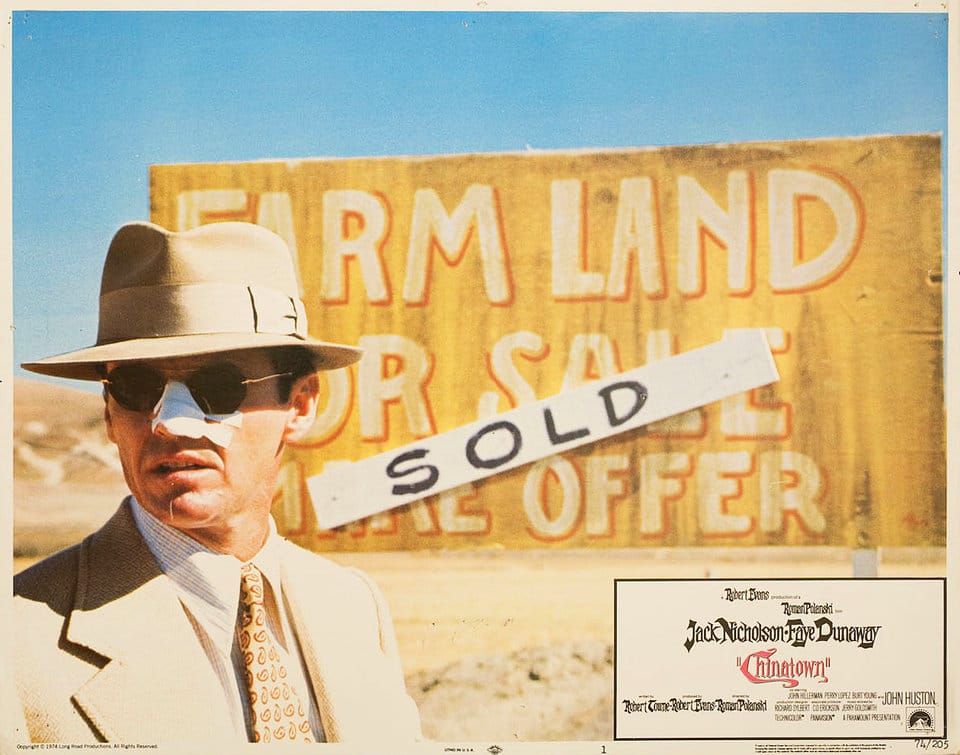
For this, I turned away from genre films, and towards tragedies like Ryan Coogler's Fruitvale Station as well as heist scripts like Russell Gewirtz's Inside Man. And of course, I read the only Academy Award-winning script about water rights, Robert Towne's Chinatown. Scripts read pretty quickly and there are a lot of books and creators who opine on the topic. I ended up reading the current bible for the industry, Blake Snyder's Save the Cat! If you're also writing nonfiction, I wouldn't bother; it's a very pompous book from the man whose crowning achievement is the 1994 Macaulay Culkin vehicle Blank Check. Just watch channels that focus on technique, like Lessons from the Screenplay, Every Frame a Painting, or Moviewise.
It still has to work as nonfiction
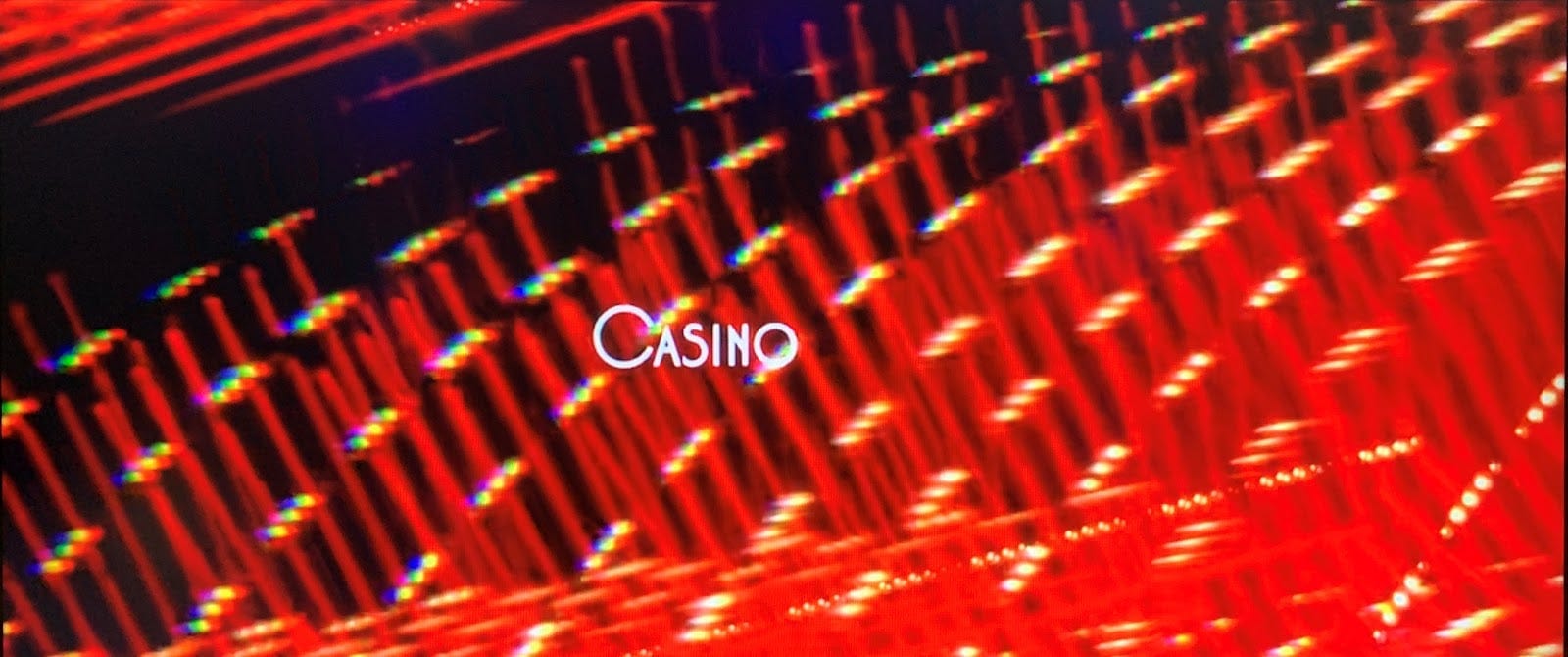
This brings us back to Casino. What I always admired about the movie is that it front-loads a staggering twenty minutes of voice-over exposition to explain how mob-run casinos work. It is the opposite of what Blake Snyder would tell you to do, but it works. That was why I used it as a model back in 2017. I needed to get through all of the background on the Reno community before I could begin the Senate hearing that served as the frame narrative. Just as Casino uses an explosive first scene to hook the audience, I started with a dramatic run to confront a Congressman. Casino's lengthy prologue slips into the inciting incident, where Robert DeNiro's main character encounters the love interest played by Sharon Stone. I tried to do the same with the hearing. I am happy with the result.
However, when I read Casino's script in 2022, I was taken aback. The prologue is just a string of repetitive vignettes. It became clear how much the performances, direction, music, and editing carry what is just a litany of crime facts. The experience was a reminder that the key to lifting from one medium to another is to understand why something works in the source. It had been enough to eyeball the movie as a model for 2,000 words, but it wasn't going to work for 20,000.
Eric Roth and Martin Scorsese faced a similar issue when they adapted Killers of the Flower Moon for film. Originally, they chose to tell it as a straightforward detective story, expanding the middle chronicle. However, at the insistence of Leonardo DiCaprio, they turned it into a more typical Scorsese story about a venal antihero who descends into a life of crime. In both cases, the material from the first and third chronicles was reduced to subplots and expository bookends. On the other hand, I think a film made with Grann's structure would have been very unusual for a Hollywood audiences. Different mediums and different markets invite different approaches to storytelling.
So—did I end up making the book into a heist story?
Well, I can't say for sure until it is published, but the answer is yes and more. For the overall concept, I am using the framing of a whodunnit detective story. The draft begins with the crime scene and asks why it happened. From there, it proceeds through three thematically different sections. First is a joint coming-of-age story for Reno and Francis Newlands that allows me to do a gentle literature review. The second, where different groups compete to reshape the United States by reinventing DC, leans more into heist dynamics. Then after 1926, I trace the impact of this transformation on different groups through a series of biographical studies. Through all of these, I am trying to align narrative and argument within each chapter, recapitulating or breaking from the larger structure as required.
It is still a nonfiction book, just as a building is still a building even if it borrows from a hummingbird. I do not want readers to see the alignment of structure and argument. I want them to feel it. Nor do I want my audience to see quotations build characters like dialogue. I want them to understand why they played their role in history. If I really have succeeded in metabolizing these ideas, then they should be invisible to all but the most astute readers. My hope is that when the book is in your hands, page will turn after page, and all you see is the tragic crossing of the neighborhood called Reno and the American Civic Association.
Ackroyd, Peter. London: The Biography. London: Random House, 2001.
Brechin, Gray. Imperial San Francisco: Urban Power, Earthly Ruin. Berkeley: University of California Press, 2006.
Caro, Robert. The Power Broker: Robert Moses and the Fall of New York. New York: Knopf, 1974.
Coogler, Ryan. Fruitvale. Screenplay. Unpublished, 2012.
Cronon, William. Nature's Metropolis: Chicago and the Great West. New York: Norton, 1991.
Davis, Mike. City of Quartz: Excavating the Future in Los Angeles. New York: Verso, 2006.
Gewirtz, Russell. "The Inside Man." Screenplay. Unpublished, 2005.
Grann, David. Killers of the Flower Moon: The Osage Murders and the Birth of the FBI. New York: Doubleday, 2017.
Larson, Erik. The Devil in the White City: Murder, Magic, and Madness at the Fair that Changed America. New York: Crown Books, 2003.
Pileggi, Nicholas and Martin Scorsese. Casino. Screenplay. Unpublished, 1995.
Roth, Eric and Martin Scorsese. Killers of the Flower Moon. Screenplay. Unpublished, 2022.
Rothstein, Richard. The Color of Law: A Forgotten History of How Our Government Segregated America. New York: Liveright, 2017.
Snyder, Blake. Save the Cat! The Last Book on Screenwriting You'll Ever Need. Los Angeles: Michael Wiese Productions, 2005.
Towne, Robert. Chinatown. Screenplay. Unpublished, 1973.
Wilkerson, Isabel. The Warmth of Other Suns: The Epic Story of America's Great Migration. New York: Random House, 2010.
She still had it at 102: