Can Trump build all of this?
The shock of the East Wing's demolition has made it seem like the president can do anything. But some of Trump's projects face much bigger challenges than others. All of these projects will take time and cost money. They are racing against the clock of the midterms and a body that is visibly ill. While it is unlikely that this Congress would stop the President's efforts, one that has Democratic majorities probably would. It's an easy political win. And if Trump finds out if he's going into heaven before then, his successor may not share his enthusiasm for any or all of these projects. All this to say, if someone were trying to stop these projects, the pressure of time means that delays can add up into a denial. There is no reason not to be maximally obstructive.
I have divided this administration's projects into three categories:
- Projects that face few challenges;
- Projects that have serious but not impossible barriers;
- Projects that face major barriers to completion.
Some projects that face few challenges
Of Trump's pet projects, I estimate that the Kennedy Center renovation is the most likely to happen. The memo obtained by NPR outlines a reasonable scope of work. The money was appropriated in the One Big Beautiful Bill. The building is publicly owned, but it is maintained by a private board that he controls. The original 1973 building is not a registered landmark (the Center is too powerful to let that happen), but it was deemed eligible for landmarking in 2012 and so any changes to public spaces, interior and exterior should have to undergo Section 106 review. The 2019 addition is not protected at all. Alterations to the complex would still have to go to NCPC and CFA and undergo an Environmental Assessment. But again, none of these are serious impediments as the president controls all of the agencies involved. Plus, the columns were repainted without 106 review, and nobody tried to stop it. I expect an organization to sue once the plans are announced and there are grounds to claim injury.
As far as the President's attempt to rename the Kennedy Center after himself, that does seem fairly unlawful to me and a lawsuit has been filed claiming so. But again, I am not a lawyer.
I think we will see more minor renovations and redecorating at the White House, unless Congress reduces his authority to do so. There are no real guardrails and Trump clearly enjoys it.
The big projects that were already underway, like the renovation and expansion of Dulles, Commanders Stadium, and the redesign of Pennsylvania Avenue, will lumber along, deferring to Trump as required. I suspect the administration will force changes based on nihilistic culture war grievances and insist on classicizing features. These projects have secure funding sources, they have legislative support, and they have the backing of economic interests the President respects. Watchdogs have their eyes on these sites, but the administration has not advanced anything transgressive there—yet.
The longstanding and bipartisan support for selling off unwanted federal buildings in Southwest means that the disposition will probably proceed. The union that represents HUD workers has sued to block relocation, and that may delay it, but there is so much inertia, I am skeptical much can happen. Preservation groups will almost certainly watch the Cohen and HUD buildings, but if the GSA includes preservation covenants, they may choose not to fight. Likewise, preservationists will fight the demolition of historic buildings at the DHS Headquarters, but DHS has chafed at the constraints of that site since it was created. There is a lot of inertia and not a lot of public attention on them.
Smaller projects, like the park renovations, are funded and face no obstacles. The principal downside of these projects will probably be more security structures and surveillance.
Projects that face some challenges
This may surprise people, but I actually think the prospects of the Ballroom are hazy. On one hand, it's under construction. He controls the boards. He controls the processes. He seems to control the money. I see no serious technical obstacles. On the other, it is a big, easy political target and it takes a long time to build habitable sub-grade structures. With no intervention, I think they will not be pouring concrete at grade level until fall 2026. If Democrats take control of the House of Representatives, they could pass provisions to stop the Ballroom, even if Republicans retain control of the Senate. The latitude Congress has will be even greater if the lawsuit filed by the National Trust for Historic Preservation succeeds. Taking the approach of throwing everything at the wall, nothing has stuck enough to get an injunction. However, legal analysts seem to think that the judge offered the Trust a clear pathway to a stop-work order. Observing that Congress had delegated sufficient authority to the president to do construction projects on the White House Grounds, that authority had limits. Analysts suggest that the Trust could then allege that the President exceeded the authority granted to him. Even if the lawsuit does not prevail, the projed a hostile Congress or a specific act of God's mercy can stop the project before it gets above grade. If Republicans hold the House, then I would expect the ballroom to proceed to completion. Even if courts rule that he exceeded authority in construction, the next appropriations bill could include provisions that authorize it.
A lot has to happen for the redevelopment of the Hoover building to proceed. The FBI must relocate to its new location, which means the new headquarters must be built or renovated. The current building is massively overbuilt, meaning that demolition will be expensive and time-consuming. Developers will prefer the site "clean," that is, with no structures on it.
I do not understand the circumstances of NPS concession contracts to make an assessment about the public golf courses to make an assessment. The DC Preservation League has already filed a lawsuit about dumping White House construction waste in the Potomac Park course. With so many users and interested parties, it does seem like there is ample opportunity for more litigation. Whether that will be impactful, I do not know.
The effort to white out the Eisenhower Executive Office Building faces a lot of resistance, but the administration continues to advance it. Almost immediately after it the plan was announced, the DC Preservation League and Cultural Heritage Partners filed a lawsuit to block the effort. The purpose of the suit is to force the administration to put the paint job through the Environmental Analysis and Section 106 processes, as required by law. Almost everything known about the project has come from filings in the case. Most importantly, the administration appears to have lied to the court by promising to not advance the project until March 2026, but executed an agreement transferring control of the project from the GSA to the Executive Office of the President. Again, every action in this case justifies not trusting the administration.
Projects that face major challenges
Unlike the Ballroom, The Garden of Heroes explicitly requires congressional approval and the most intensive review process in DC. This is because it is a "commemorative work" under the CWA (or really, 250 of them), and the administration seems want to build it in the Reserve, the portion of the monumental core that was roped off in 2003. It is possible for the president to get an exception. After all, he got money appropriated for it in the OBBB. But it would require more effort from his administration than they have displayed over the six years this project has been in development. Indeed, the biggest gesture was the announcement of grants. The lack of awards makes me wonder whether they ran out of money when the administration was forced to fulfill some prior NEH grants.
Meanwhile, sculptors have been fairly unanimous that $200,000 barely covers materials, sculpting, fabrication and delivery for a statue of that size. At any rate, there are less than ten sculptors in the United States that can make a good portrait statue, and they certainly cannot churn out 25 per year. Finally, the $40M funding for the garden setting seems low given the amount of utility work, landscaping, lighting, pedestals, paths, support facilities, and security elements for a site of this kind. I mean, both East and West Potomac Parks are 100% soggy silt. NPS just rebuilt embankment walls around the area after they subsided up to five feet—for the second time. To ensure they last this time, they used using over 700 89' steel piles, plus a second row of sheet piling. Similarly vast foundations were required for the adjacent FDR and MLK memorials, in addition to soil stabilization, i.e. mixing it with gravel and cements. The FDR spreads 10 major sculptures over 330,000 square feet. It cost $48M in 1997 dollars, or around $110M after the inflationary shocks of the 2020s. So, if the administration wants to build this park properly (if), there is just no doubt in my mind that it will cost way more.
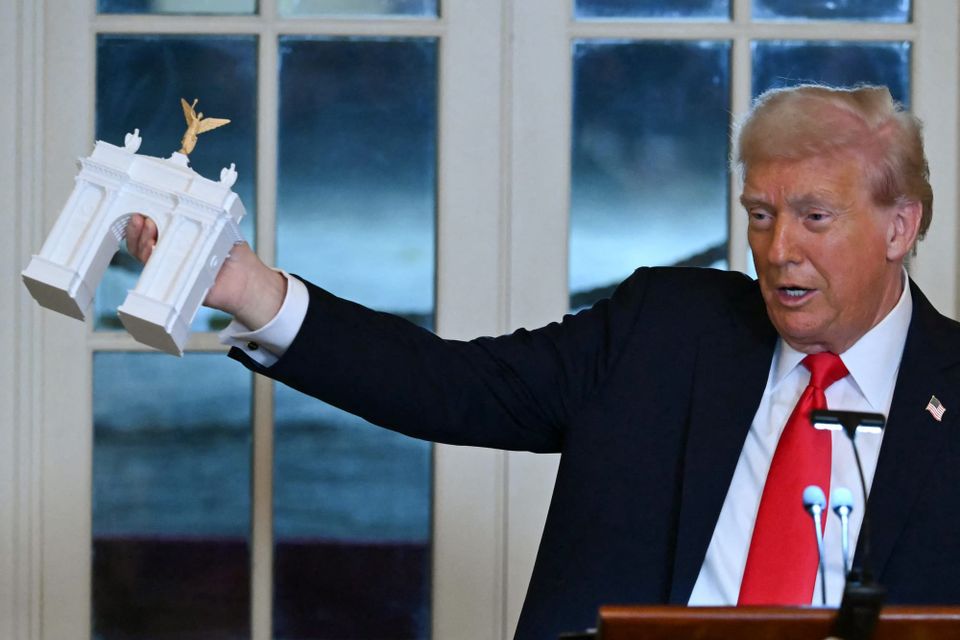
Rounding this section out, I think that the project that is least likely to happen is the big Arch. It will be very expensive and there is no money appropriated for it. Stone is heavy, meaning that the structure must also be massive, and therefore expensive. I am skeptical that in 2026, corporate donors are ready to pony up another few hundred million dollars. No matter how perfunctory design review is, it will take time, and there are robust grounds to sue. A veteran's group already has done so, on the grounds that it requires congressional authorization under the CWA. I think this is correct. As with the Garden, whether Trump can get requisite authorization depends on very favorable political conditions in at least a year.
Even with allies in the 120th Congress, the absurd scale of the structure presents major technical challenges. Like the Potomac Parks on the other side of the river, Columbia Island is not natural, but is instead made out of dredged silt. It has had settling problems since forever. A massive stone structure like the one envisioned would require a very deep foundation. Such a structure would take a long time to construct and cost a lot of money. Similarly, the island sits very close (if not directly under) the path of aircraft approaching National Airport. At nearly twice the general height limit of buildings in DC, it could present a serious hazard to commercial aviation. National Airport essentially remains open because it is so convenient for Members of Congress and their staff. I strongly doubt they or the airlines will want to make flying more difficult.
DC's future is more uncertain than ever.
Next page: What to read. (coming soon)
Back to the index.